

Self-employment tax is a payroll tax that applies to net earnings from self-employment. When you earn both W-2 and 1099 income, the tax is calculated only on your net self-employment earnings, not on your total income. The IRS uses a specific formula to determine your net earnings subject to self-employment tax, which then determines your liability. This guide explains how the calculation works and how to manage your payments effectively.
How Self-Employment Tax Works
Self-employment tax is the mechanism by which self-employed individuals pay Social Security and Medicare taxes. Unlike W-2 employees, who split these taxes with their employer, self-employed individuals pay the full amount. The current rate is 15.3%, which covers 12.4% for Social Security and 2.9% for Medicare. This tax is calculated on your net profit from self-employment, which is your gross income minus allowable business expenses.
The Impact of W-2 Income
Your W-2 income does not directly reduce your self-employment tax liability. The self-employment tax is calculated solely on your net self-employment earnings. However, your W-2 income does affect your overall federal income tax bracket. Higher total income can push you into a higher tax bracket, which increases the income tax portion of your liability but does not change the self-employment tax calculation itself.
It is important to note that the Social Security wage base limit applies to your combined W-2 and self-employment earnings. Once your combined earnings exceed the annual wage base limit, you no longer owe the Social Security portion of self-employment tax on additional self-employment income. You will still owe the Medicare portion, which has no wage base limit. This cap can significantly reduce your self-employment tax burden if your total income is high.
Managing Quarterly Estimated Payments
Self-employed individuals are required to make quarterly estimated tax payments to the IRS. These payments cover both your self-employment tax and your federal income tax. The IRS expects you to pay at least 90% of your current year's tax liability or 100% of your prior year's tax liability to avoid underpayment penalties. Missing these deadlines can result in interest and penalties, which can erode your profits.
Accurate estimation is key to avoiding these penalties. You need to project your net self-employment income for the year and calculate the corresponding self-employment tax. Tools like quarterly tax deadline trackers can help you stay on schedule. By monitoring your income and expenses in real-time, you can adjust your estimated payments as needed to ensure you meet the IRS requirements.
Deductible Business Expenses
Reducing your net self-employment income is the most effective way to lower your self-employment tax. You can deduct ordinary and necessary business expenses from your gross income. Common deductions include home office expenses, software subscriptions, and business mileage. The standard mileage rate for 2026 is 72.5 cents per mile, and you must properly document your business mileage to support this deduction.
Proper documentation is essential for claiming these deductions. You should keep detailed records of all business expenses, including receipts and logs. Tools like freelancer expense trackers can help you categorize and store these records efficiently. By maximizing your deductions, you reduce your net profit, which in turn lowers the amount subject to self-employment tax. This strategy can save you significant money over the course of the year.
Tracking Your Income and Expenses
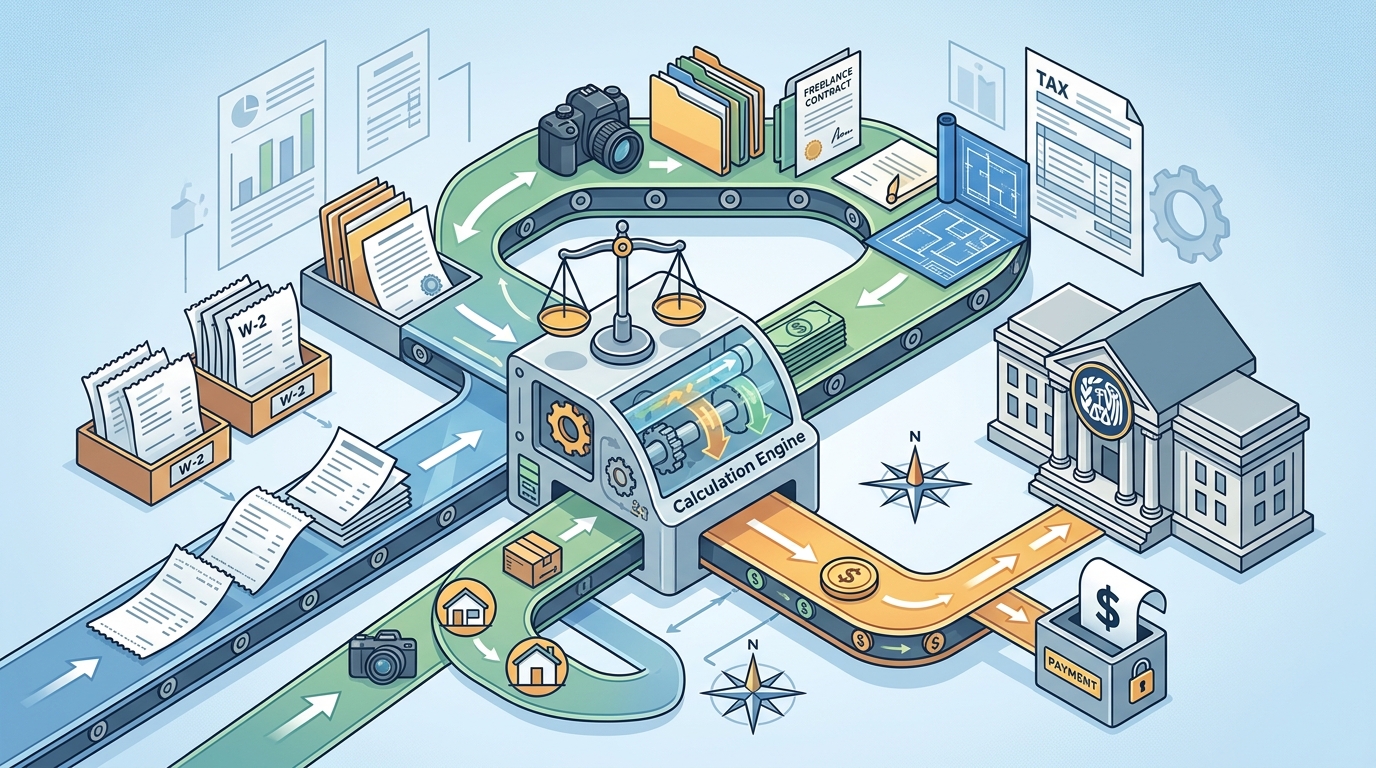
Effective tax planning requires accurate tracking of your income and expenses throughout the year. Many freelancers rely on spreadsheets or manual logs, which can be time-consuming and prone to errors. Dedicated tax planning software can automate this process, providing real-time insights into your financial situation. These tools help you see your projected tax liability as you go, allowing you to make informed decisions about your spending and savings.
Using a tool like SnapTax can simplify this process by integrating income tracking, expense management, and tax estimation in one platform. This approach ensures that you have a clear picture of your financial health at all times. By staying on top of your numbers, you can avoid surprises at tax time and make better financial decisions throughout the year.
Key Takeaways
- Self-employment tax is calculated only on net self-employment earnings, not on total income.
- The current self-employment tax rate is 15.3%, covering Social Security and Medicare.
- Your W-2 income affects your income tax bracket but not the self-employment tax calculation.
- The Social Security wage base limit caps the amount of self-employment income subject to the Social Security tax.
- Quarterly estimated payments are required to avoid underpayment penalties.
- Deducting business expenses reduces your net profit and lowers your self-employment tax.
- Accurate tracking of income and expenses is essential for effective tax planning.
Frequently Asked Questions
Does W-2 income reduce self-employment tax?
No, W-2 income does not directly reduce self-employment tax. The tax is calculated solely on your net self-employment earnings. However, W-2 income can affect your overall income tax bracket.
What is the self-employment tax rate for 2026?
The self-employment tax rate is 15.3%, which includes 12.4% for Social Security and 2.9% for Medicare. This rate applies to your net self-employment earnings.
How do I calculate my self-employment tax?
You calculate self-employment tax by multiplying your net self-employment earnings by 92.35% and then applying the 15.3% tax rate. This gives you the total self-employment tax owed.
Do I need to make quarterly payments if I have W-2 income?
Can I deduct business mileage from my self-employment income?
Yes, you can deduct business mileage from your self-employment income. The standard mileage rate for 2026 is 72.5 cents per mile, and you must keep accurate records of your business miles.
Conclusion
Understanding self-employment tax is crucial for freelancers and 1099 workers who also have W-2 income. By knowing how the tax is calculated and managing your quarterly payments effectively, you can avoid penalties and optimize your tax liability. Use tools like SnapTax to track your income and expenses, and consult a qualified tax professional for personalized advice. Stay informed and stay compliant to protect your financial future.