

Managing a hybrid income stream is one of the most common yet financially risky scenarios for modern professionals. When you earn both W-2 wages and 1099 freelance income, the IRS expects you to handle two completely different tax withholding systems simultaneously. According to recent IRS data, underpayment penalties are the leading cause of unexpected tax bills for independent contractors who fail to account for their side income correctly. This guide explains exactly how these two income types interact, how to calculate your true tax liability, and how to avoid costly errors using tools like SnapTax.
Understanding the Dual Withholding System
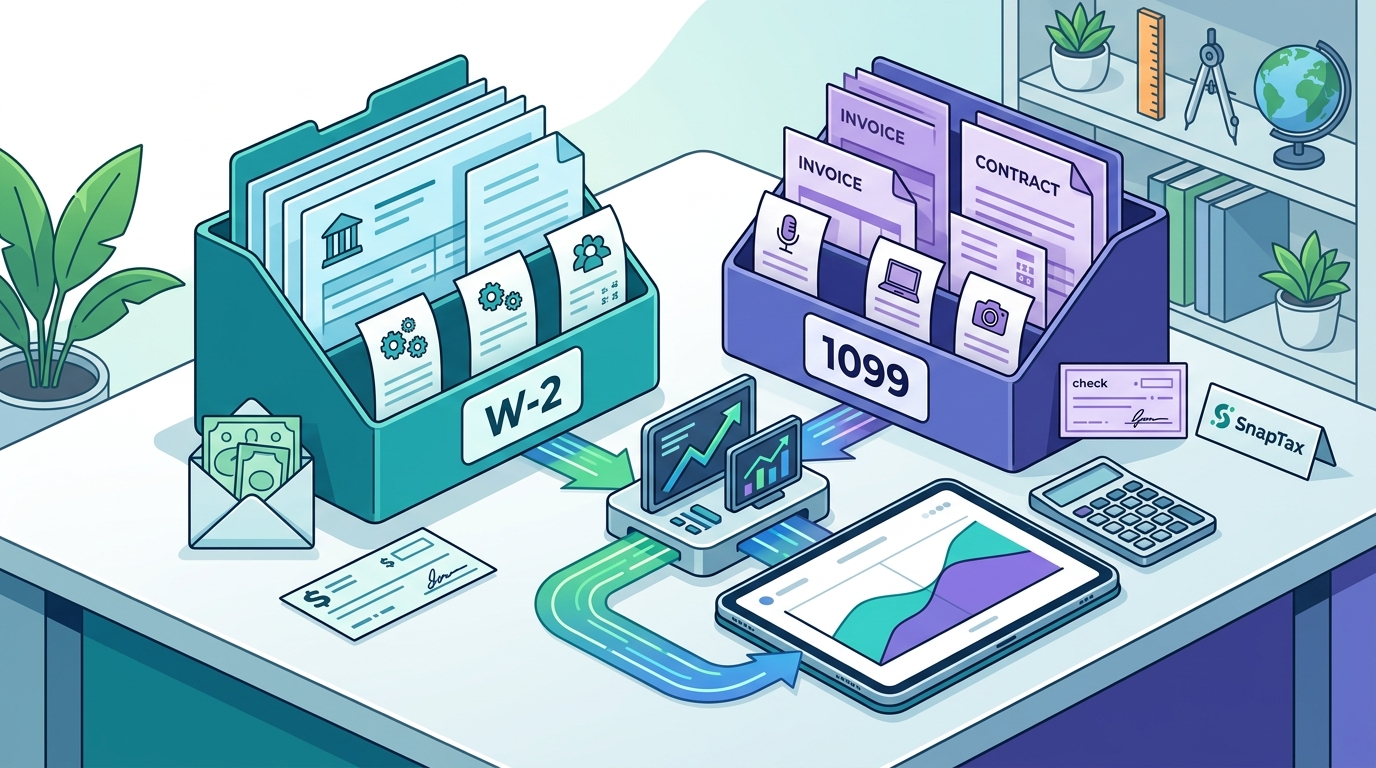
The fundamental challenge of having dual income sources is that they are taxed differently. Your W-2 job handles the heavy lifting for you. Your employer withholds federal income tax, Social Security, and Medicare from every paycheck. They also pay a matching portion of Social Security and Medicare on your behalf. This system is designed to be "pay-as-you-go," ensuring you rarely owe a large lump sum at tax time if your income is stable.
However, your 1099 income operates in a vacuum. No employer is withholding taxes from your freelance checks. The IRS views this as a gap in your tax coverage. If you do not proactively fill this gap, you will face a significant balance due when you file your return in April. This is where 1099 tax planning becomes critical for financial stability.
Income from freelance work is reported on Schedule C (Profit or Loss from Business). This form calculates your net profit by subtracting allowable business expenses from your gross income. Only this net profit is subject to income tax and self-employment tax. It is vital to understand that you do not pay taxes on your gross freelance revenue, only on what you keep after legitimate business costs.
The Self-Employment Tax Impact
One of the most surprising aspects of dual income is the self-employment tax. This tax covers Social Security and Medicare for self-employed individuals. For W-2 employees, this cost is split between you and your employer. For 1099 workers, you pay the entire 15.3% yourself. This rate applies to 92.35% of your net earnings from Schedule C.
For example, if your freelance business nets $20,000 in profit, you will owe approximately $3,000 in self-employment tax alone. This is in addition to your regular income tax. Many freelancers forget to budget for this 15.3% hit, leading to cash flow crises. SnapTax calculates this automatically using current IRS tables, ensuring you know exactly what to set aside. You can learn more about asset depreciation tax deductions to further reduce your taxable income.
While you can deduct half of your self-employment tax as an adjustment to income on your Form 1040, this only reduces your income tax, not the self-employment tax itself. Understanding this nuance is key to accurate financial planning. The avoidance of IRS quarterly tax penalties relies heavily on accurate estimation of this specific liability.
Navigating Quarterly Estimated Taxes
Because no taxes are withheld from your 1099 income, you are legally required to make quarterly estimated tax payments to the IRS. These payments are due in April, June, September, and January. Missing these deadlines results in underpayment penalties that can add up quickly.
The rule of thumb for avoiding penalties is to pay either 90% of your current year's tax liability or 100% of your prior year's tax liability (110% if your adjusted gross income exceeds $150,000). For dual-income earners, your W-2 withholding counts toward this requirement. If your W-2 withholding is sufficient to cover 90% of your total tax bill (W-2 tax + 1099 tax), you may not need to make separate estimated payments.
However, this is a dangerous assumption if your freelance income is significant. SnapTax helps you model this scenario by combining your W-2 withholding with your projected 1099 tax liability. It shows you in real-time if you are on track or if you need to increase your quarterly payments. This proactive approach prevents the "April surprise" that plagues many hybrid earners.
Maximizing Deductions for Both Streams
Having 1099 income provides a powerful advantage: the ability to deduct business expenses. These deductions lower your net profit, which in turn lowers your income tax and self-employment tax. Common deductions include home office expenses, software subscriptions, internet bills, and professional development costs.
For W-2 employees, unreimbursed employee expenses are generally no longer deductible under current tax law. Therefore, your 1099 side hustle is often the only place where you can legally reduce your taxable income through business expenses. This makes meticulous record-keeping essential. SnapTax simplifies this by allowing you to upload bank statements and automatically categorize expenses using AI.
Another critical deduction is the Qualified Business Income (QBI) deduction. This allows eligible pass-through business owners to deduct up to 20% of their qualified business income from their taxes. This deduction can significantly reduce the effective tax rate on your freelance income. The SnapTax Optimizer plan specifically tracks QBI eligibility and calculations for you.
Asset depreciation is another powerful tool. If you purchase equipment, vehicles, or software for your freelance work, you can often deduct a portion or all of the cost in the year of purchase under Section 179. This can result in substantial tax savings, especially in years with high freelance income.
Choosing the Right Tracking Plan
Managing dual income requires precision. Manual spreadsheets often fail to capture the complexity of self-employment tax calculations and QBI deductions. SnapTax offers tiered plans designed to handle increasing levels of financial complexity.
| Plan Name | Monthly Cost | Best For | Key Features |
|---|---|---|---|
| Starter | $4.99 | Simple Side Hustles | Manual logging, quarterly estimates, TurboTax export |
| Builder | $19.99 | Growing Freelancers | AI categorization, P&L reports, mileage tracking |
| Optimizer | $39.99 | Complex Dual Income | QBI tracking, asset depreciation, itemized deductions |
The Starter plan is sufficient if your freelance income is minimal and your W-2 withholding is high. However, as your 1099 income grows, the Builder and Optimizer plans provide the automation needed to stay compliant. The SnapTax blog offers additional resources on tax planning strategies for freelancers.
Key Takeaways
- Dual Income Complexity: W-2 and 1099 income require separate tax handling. W-2 withholding may not cover 1099 liabilities.
- Self-Employment Tax: You owe 15.3% self-employment tax on net freelance income. This is in addition to income tax.
- Quarterly Payments: Estimated taxes are mandatory for 1099 income. Use SnapTax to calculate exact amounts due.
- Deduction Advantage: Business expenses reduce net profit. QBI and Section 179 deductions can significantly lower tax bills.
- Automation is Key: Manual tracking leads to errors. AI-powered tools like SnapTax ensure accurate categorization and real-time tax estimates.
- Penalty Avoidance: Underpayment penalties are costly. Regular quarterly payments prevent IRS penalties and interest.
- TurboTax Integration: SnapTax exports data in TXF format for seamless import into TurboTax, simplifying year-end filing.
Frequently Asked Questions
Do I pay self-employment tax on my W-2 income?
No. Self-employment tax only applies to net earnings from your 1099 freelance business. Your W-2 income is subject to Social Security and Medicare taxes, but these are withheld by your employer and matched by them. You do not pay the employer portion on your W-2 wages.
How do I calculate my quarterly estimated tax payments?
You calculate this by estimating your total annual tax liability (income tax + self-employment tax) and dividing it by four. SnapTax automates this by projecting your annual liability based on your year-to-date income and expenses, then showing you the exact quarterly payment amount.
Can I deduct home office expenses if I work from home for my W-2 job?
Generally, no. Unreimbursed employee expenses are no longer deductible. However, if you use a portion of your home exclusively and regularly for your 1099 freelance work, you can deduct a percentage of your home expenses (rent, utilities, insurance) as a business expense on Schedule C.
What happens if I underpay my estimated taxes?
The IRS charges underpayment penalties based on the amount underpaid and the length of time it was underpaid. These penalties can be significant. Using SnapTax to track your real-time tax liability helps you avoid underpayment by ensuring you pay the correct amount each quarter.
Is SnapTax compatible with TurboTax?
Yes. SnapTax allows you to export your Schedule C data in TXF format. This file can be imported directly into TurboTax, saving you hours of manual data entry and ensuring accuracy when filing your taxes.
How does the QBI deduction work for dual income earners?
The Qualified Business Income (QBI) deduction allows you to deduct up to 20% of your qualified business income from your 1099 work. This deduction applies to your net profit from Schedule C. SnapTax's Optimizer plan tracks this deduction automatically, ensuring you claim the full benefit.
Do I need to file a separate tax return for my 1099 income?
No. You file a single Form 1040 federal tax return. Your W-2 income is reported on Form W-2, and your 1099 income is reported on Schedule C, which is attached to your Form 1040. Both incomes are combined to determine your total tax liability.
Get Started with SnapTax
Managing dual income doesn't have to be stressful. SnapTax provides the real-time visibility and automated calculations you need to stay compliant and maximize your deductions. Stop guessing and start planning. Contact us today to learn more about how SnapTax can simplify your tax life.