

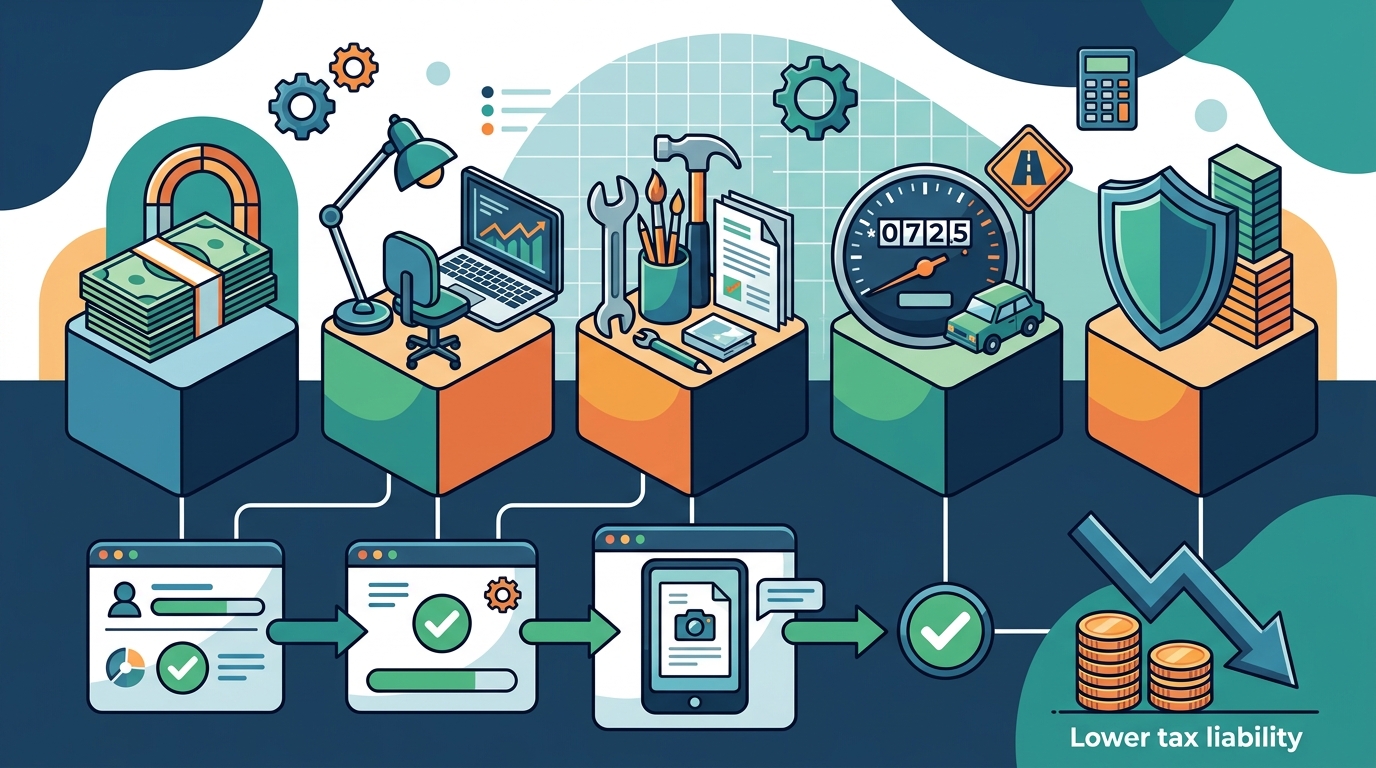
Self-employed individuals can claim five major deduction categories in 2026: retirement plan contributions, home office expenses, ordinary business costs, vehicle mileage, and the qualified business income deduction. These deductions reduce your taxable income and lower your overall tax liability. This guide explains how each deduction works, the specific 2026 limits, and how to document them properly using tools like SnapTax.
Retirement Plan Contributions
Retirement plan contributions are a powerful deduction for self-employed workers because they reduce taxable income while building future security. The IRS allows self-employed individuals to contribute to several types of retirement accounts, each with different contribution limits and eligibility rules. Choosing the right plan depends on your income level, business structure, and long-term financial goals.
SEP IRA
Solo 401(k)
Documentation Requirements
To claim these deductions, you must accurately calculate your net self-employment income. This requires tracking all business income and expenses throughout the year. SnapTax expense tracking helps you maintain the records needed to verify your contribution amounts during an audit.
Home Office Deduction
The home office deduction is a tax benefit that allows self-employed individuals to deduct a portion of their home expenses if they use part of their home regularly and exclusively for business. This deduction covers costs like rent, mortgage interest, utilities, insurance, and repairs. There are two methods to calculate this deduction: the simplified method and the regular method.
Simplified Method
Regular Method
The regular method allows you to deduct a percentage of your actual home expenses based on the proportion of your home used for business. For example, if you use 20% of your home for business, you can deduct 20% of your rent, utilities, and other eligible expenses. This method often results in a larger deduction but requires more detailed record-keeping.
Eligibility Criteria
To qualify for the home office deduction, the space must be used regularly and exclusively for business. You cannot use the space for personal activities during the time it is used for business. Additionally, the home office must be your principal place of business. If you work from multiple locations, you must use the home office more than any other location.
Ordinary Business Expenses
Ordinary business expenses are costs that are common and necessary for your specific industry. The IRS allows you to deduct these expenses if they are directly related to generating income. Examples include software subscriptions, office supplies, professional development, and marketing costs. Proper categorization is critical to maximizing your deductions and avoiding audit issues.
Common Deductible Expenses
AI-Powered Categorization
Manually categorizing hundreds of transactions is time-consuming and error-prone. SnapTax AI categorization automatically sorts your bank transactions into Schedule C categories, ensuring that no deductible expense is missed. This feature saves hours of bookkeeping time and improves the accuracy of your tax estimates.
Receipt Management
The IRS requires you to keep records of all business expenses. This includes receipts, invoices, and bank statements. SnapTax receipt management allows you to snap, email, or upload receipts, with OCR technology extracting vendor, amount, and date automatically. This creates an audit-ready trail of your expenses.
Vehicle Mileage Rates
Vehicle mileage is one of the most common deductions for self-employed individuals who travel for business. The IRS allows you to deduct the cost of using your personal vehicle for business purposes. For 2026, the standard mileage rate is 72.5 cents per mile. This rate covers gas, oil, maintenance, repairs, insurance, and depreciation.
Standard Mileage Rate
Documentation Requirements
Business vs. Personal Miles
You can only deduct miles driven for business purposes. Commuting from home to a regular workplace is not deductible. However, if you work from home and drive to a client site, those miles are deductible. It is important to distinguish between business and personal miles to avoid overclaiming.
QBI Deduction
The Qualified Business Income (QBI) deduction is a tax benefit that allows self-employed individuals to deduct up to 20% of their qualified business income. This deduction was introduced by the Tax Cuts and Jobs Act and is available through 2025, with potential extensions beyond that date. The QBI deduction can significantly reduce your taxable income, especially for those in higher tax brackets.
Income Thresholds
Specified Service Trades or Businesses
Calculating QBI
Qualified business income is your net profit from your business, minus certain deductions like the self-employment tax deduction and qualified business income deduction. SnapTax 1099 tax calculator helps you estimate your QBI deduction based on your income and business type. This tool provides a real-time picture of your federal and state tax liability, including the impact of the QBI deduction.
Key Takeaways
- The home office deduction allows you to deduct a portion of your home expenses if used regularly and exclusively for business.
- The 2026 standard mileage rate is 72.5 cents per mile, and proper documentation is required to claim the deduction.
- The QBI deduction allows you to deduct up to 20% of your qualified business income, subject to income thresholds.
- Using tax planning software like SnapTax helps you track income, expenses, and mileage to maximize your deductions.
- Proper record-keeping is essential to support your deductions and avoid audit issues.
- Consult a qualified tax professional for personalized guidance on your specific situation.
Frequently Asked Questions
What is the 2026 standard mileage rate?
The 2026 standard mileage rate is 72.5 cents per mile. This rate covers gas, oil, maintenance, repairs, insurance, and depreciation.
Can I deduct my home office if I work from home part-time?
Yes, you can deduct your home office if you use part of your home regularly and exclusively for business. The space must be your principal place of business.
What is the maximum retirement contribution for self-employed individuals in 2026?
Do I need to keep receipts for all business expenses?
Yes, you need to keep receipts for all business expenses. The IRS requires documentation to support your deductions. Using a tool like SnapTax can help you manage your receipts digitally.
What is the QBI deduction?
The QBI deduction is a tax benefit that allows self-employed individuals to deduct up to 20% of their qualified business income. This deduction is subject to income thresholds and limitations for certain types of businesses.
Can I use the simplified method for the home office deduction?
How do I track my business miles?
You can track your business miles using a manual log or a GPS-based mileage tracker. SnapTax offers a GPS-based mileage tracker that automatically logs your business miles and creates an IRS-compliant audit log.
Is SnapTax a tax preparation service?
No, SnapTax is a tax planning and estimation tool. It is not a tax preparation service or a substitute for professional tax advice. You should consult a qualified tax professional for personalized guidance.
Conclusion
Maximizing your tax deductions in 2026 requires a clear understanding of the rules and consistent record-keeping. By leveraging retirement plan contributions, the home office deduction, ordinary business expenses, vehicle mileage, and the QBI deduction, you can significantly reduce your taxable income. Tools like SnapTax make it easier to track your income, expenses, and mileage, ensuring that you do not miss any deductions. Remember that SnapTax is a planning tool, not a tax advisor. For personalized guidance, consult a qualified tax professional. Start your tax planning today by visiting SnapTax.