

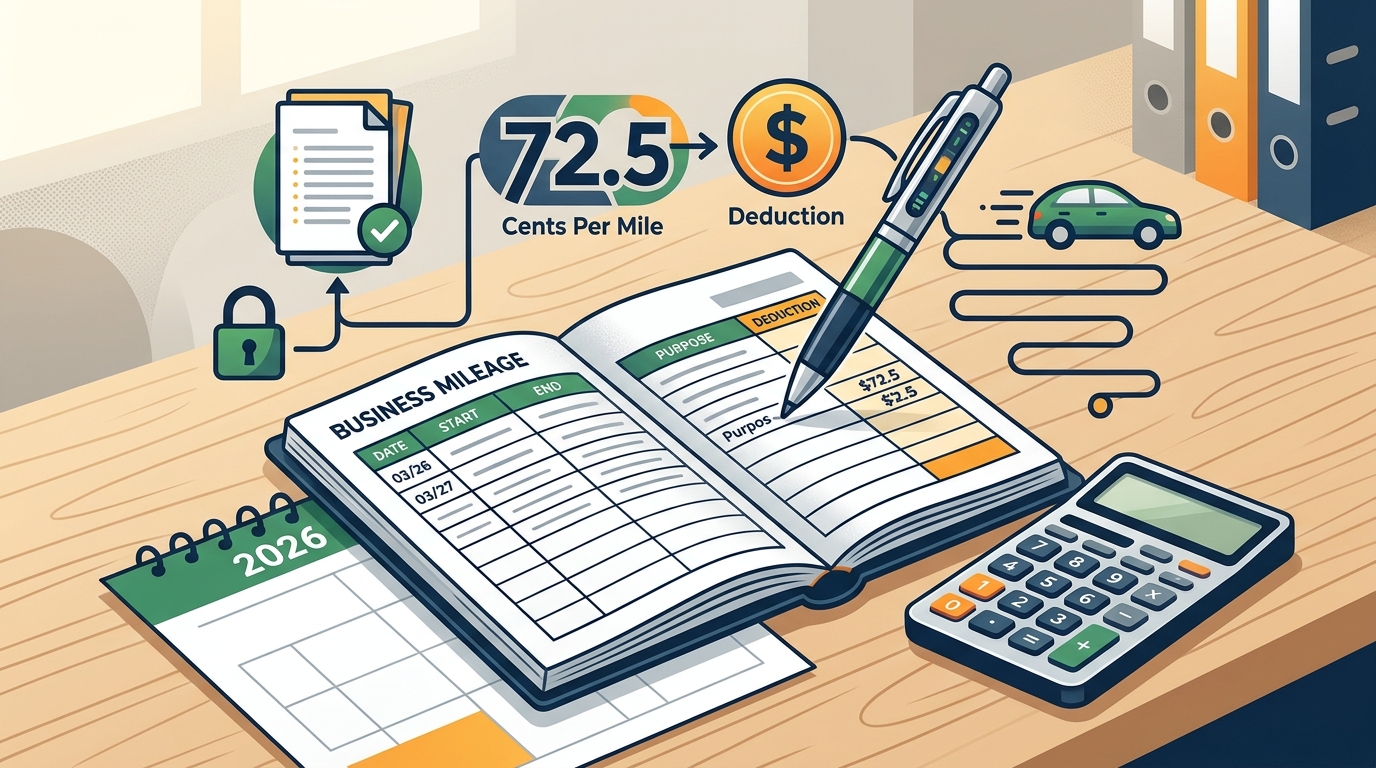
The 2026 standard mileage rate is 72.5 cents per mile for business use. This rate allows freelancers to deduct vehicle costs without tracking individual expenses like gas or oil. Proper documentation of business miles is required to support this deduction on your tax return. SnapTax helps you track these miles accurately throughout the year.
Understanding the 2026 Rate Structure
The Internal Revenue Service announced that the optional standard mileage rate for business use of automobiles will increase by 2.5 cents in 2026. The rate is set at 72.5 cents per mile for miles driven from January 1 through June 30, 2026. For miles driven from July 1 through December 31, 2026, the rate increases to 76 cents per mile. This two-tier structure reflects changes in fuel prices and vehicle operating costs during the year. You must apply the correct rate based on the date each mile was driven.
The IRS confirmed this rate increase in their official announcement. Notice 2026-10 provides the optional 2026 standard mileage rates and the maximum fair market value of employer-provided automobiles. Understanding this split is critical for accurate annual calculations. Many freelancers mistakenly use a single average rate for the entire year, which can lead to underreporting or overreporting their deduction.
Documentation Requirements for Deductions
Standard mileage deduction is a per-mile deduction that requires specific recordkeeping to be valid. The IRS requires you to maintain a log that includes the date, destination, business purpose, and total miles driven for each trip. This log must be kept for at least three years from the date you filed your original return. Without this documentation, the IRS can disallow the entire mileage deduction during an audit.
Calculating Your Deduction Amount
This deduction reduces both your federal income tax and your self-employment tax. Because self-employment tax is calculated on your net profit, lowering your profit through deductions like mileage directly reduces the 15.3% self-employment tax liability. This dual impact makes mileage one of the most valuable deductions for freelancers. You can use the self-employment tax calculator to see how this deduction affects your total liability.
Automating Mileage Tracking with SnapTax
Manual mileage tracking is prone to errors and omissions. Digital tools eliminate these risks by using GPS data to log trips automatically. SnapTax is built specifically for 1099 workers and includes a GPS mileage tracker that distinguishes between business and personal driving. The app generates a real-time view of your deductible miles, ensuring you never miss a trip.
Using a dedicated tool like SnapTax saves time and improves accuracy. It integrates mileage data with your other expenses and income to provide a complete picture of your tax liability. You can view your projected quarterly tax payments based on your actual mileage and other deductions. This real-time visibility helps you plan your cash flow and avoid underpayment penalties. To see how this works, you can explore the SnapTax features page for more details on the mileage tracker. according to Internal Revenue Service
Avoiding Common Mileage Deduction Errors
One common mistake is failing to separate business miles from personal miles. If you use your car for both work and personal errands, you must only deduct the business portion. Another error is using the standard mileage rate after having used the actual expense method in the first year. The IRS rules are strict about switching methods. Once you choose actual expenses, you generally cannot switch to standard mileage later without specific conditions being met.
Additionally, some freelancers forget to account for the two different rates in 2026. Using the 72.5 cent rate for the entire year will understate your deduction for miles driven in the second half. Always check the date of the trip to apply the correct rate. Keeping a clear, organized log prevents these errors and ensures your deduction is fully supported. You can review the mileage and expense tracking guide for more tips on avoiding these pitfalls.
Key Takeaways
- The 2026 standard mileage rate is 72.5 cents per mile for January through June and 76 cents per mile for July through December.
- You must maintain a detailed log of business miles, including date, destination, and purpose, to support the deduction.
- The mileage deduction reduces both federal income tax and self-employment tax, maximizing your savings.
- Automated tools like SnapTax help track miles accurately and generate IRS-compliant audit logs.
- Do not mix business and personal miles; only deduct the portion used for business purposes.
- Be aware of the rules regarding switching between standard mileage and actual expense methods.
Frequently Asked Questions
What is the standard mileage rate for 2026?
The standard mileage rate for 2026 is 72.5 cents per mile for miles driven from January 1 to June 30, and 76 cents per mile for miles driven from July 1 to December 31.
Do I need to keep receipts for gas if I use the standard mileage rate?
No, you do not need to keep receipts for gas, oil, or other vehicle expenses if you use the standard mileage rate. You only need to keep a log of your business miles.
Can I use the standard mileage rate for a leased vehicle?
Yes, you can use the standard mileage rate for a leased vehicle. However, if you use the actual expense method, you cannot deduct the lease payments in full if you also claim the standard mileage rate for the same vehicle in a later year.
How does the mileage deduction affect my self-employment tax?
The mileage deduction reduces your net profit from self-employment. Since self-employment tax is calculated on this net profit, a higher mileage deduction results in a lower self-employment tax liability.
What happens if I don't keep a mileage log?
If you cannot provide a reasonable estimate or log of your business miles, the IRS may disallow your mileage deduction entirely. This can result in higher taxes and potential penalties.
Can I switch from the standard mileage rate to actual expenses later?
Yes, you can switch from the standard mileage rate to the actual expense method in a later year. However, if you start with actual expenses, you generally cannot switch to the standard mileage rate later without meeting specific IRS conditions.
Start Tracking Your Miles Today
Understanding and applying the 2026 standard mileage rate is essential for maximizing your tax deductions as a freelancer. By using the correct rates and maintaining proper documentation, you can significantly reduce your taxable income and self-employment tax. SnapTax makes this process simple and accurate with its automated mileage tracking and real-time tax estimates. Visit SnapTax to start tracking your miles and planning your taxes today.