

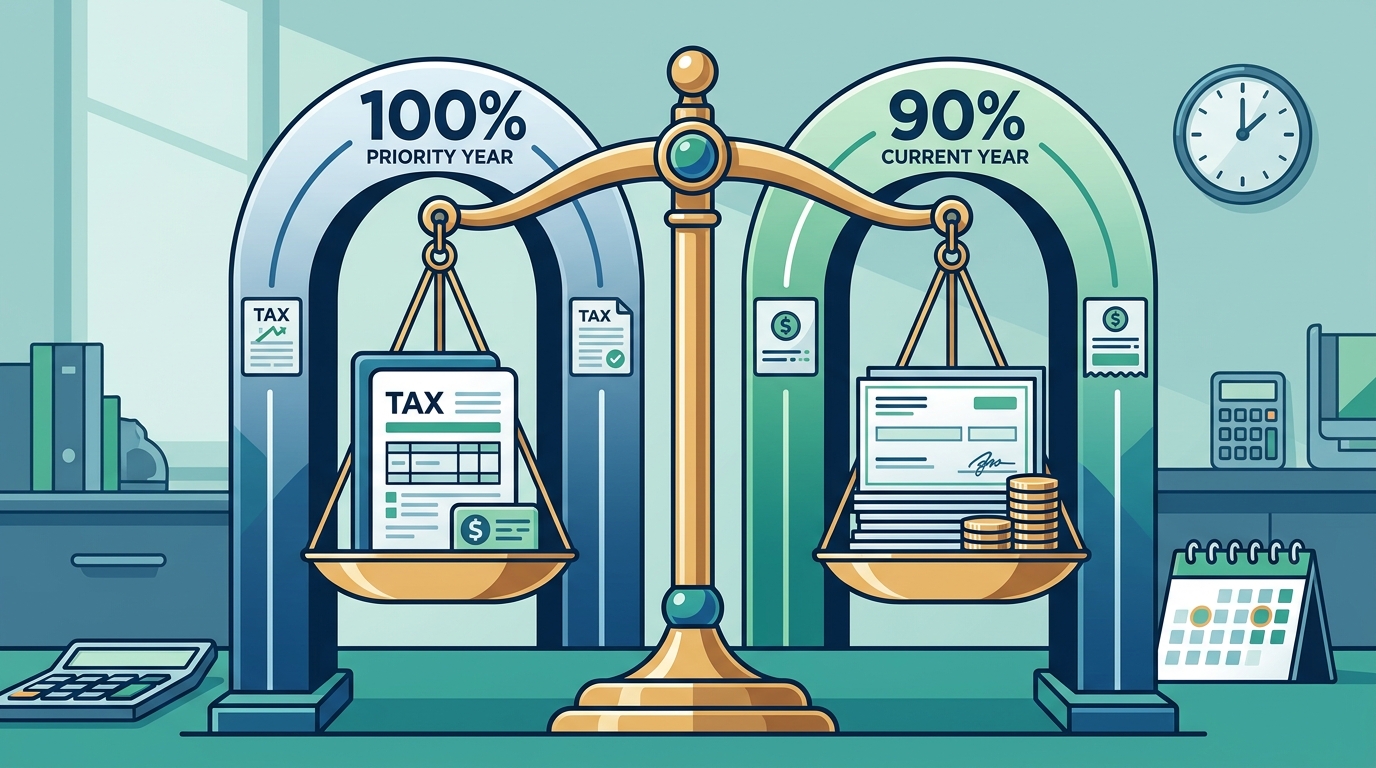
For 2026, you avoid underpayment penalties by paying at least 90% of your current year tax liability or 100% of your prior year tax liability. The IRS applies these safe harbor rules to determine if your quarterly estimated tax payments are sufficient. Missing these thresholds can result in penalties when you file your annual return, even if you pay the full balance in April.
Understanding the Safe Harbor Concept
The safe harbor rule is a provision in the Internal Revenue Code that protects taxpayers from underpayment penalties if they meet specific payment thresholds. It is designed to ensure that taxpayers contribute to the federal government's revenue stream throughout the year, rather than paying a lump sum at the end of the tax year. For freelancers and 1099 workers, this concept is critical because there is no employer withholding taxes from their paychecks.
Understanding these definitions is the first step in planning your cash flow. You do not need to know your exact current year tax liability to use the prior year safe harbor. This makes it a practical tool for freelancers whose income fluctuates. If your income is stable, the prior year safe harbor is often the easiest method to follow.
Calculating the 90% Current Year Threshold
The current year safe harbor requires you to pay 90% of your estimated tax liability for the current year. This calculation is more complex because it requires you to project your income and deductions for the entire year. You must estimate your total income, subtract deductions and credits, and apply the appropriate tax rates to determine your total tax liability. Then, you multiply that number by 90% to find your safe harbor amount.
Using a tax planning tool can simplify this process. SnapTax 1099 tax calculator helps you project your federal and state tax liability in real time. It uses current IRS tax brackets and self-employment tax rates to provide an accurate estimate of your annual tax owed. This allows you to adjust your quarterly payments as your income changes throughout the year.
Applying the Prior Year Safe Harbor
However, the prior year safe harbor has a limitation. If your income increases significantly, you may end up owing more than the prior year threshold. In this case, you should consider using the current year safe harbor instead. You can also use a combination of both methods. For example, you can pay the prior year safe harbor amount for the first three quarters and then adjust your fourth quarter payment to meet the 90% current year threshold.
Managing Quarterly Payment Deadlines
The IRS requires you to make four estimated tax payments each year. The deadlines for 2026 are April 15, June 15, September 15, and January 15 of the following year. If a deadline falls on a weekend or holiday, the payment is due on the next business day. Missing a deadline can result in an underpayment penalty, even if you pay the full balance when you file your return.
Tracking your payments is essential to staying in the safe harbor. SnapTax quarterly tax deadlines feature provides a dashboard that shows your payment history and upcoming due dates. It also sends email reminders to ensure you do not miss a deadline. This feature is available on all SnapTax plans, including the free plan. It helps you stay organized and avoid the stress of last-minute payments.
Documenting Business Mileage for Deductions
Business mileage is a common deduction for freelancers who travel for work. The standard mileage rate for 2026 is 72.5 cents per mile. This rate covers the costs of operating your vehicle, including gas, oil, tires, and depreciation. To claim this deduction, you must properly document your business miles. The IRS requires you to keep a log that includes the date, destination, purpose, and number of miles driven for each business trip.
Proper documentation is critical to support your deduction. If the IRS audits your return, you must be able to provide a detailed mileage log. Without proper documentation, the IRS may disallow your mileage deduction, which could increase your tax liability and potentially trigger a penalty. A GPS-based mileage tracker can help you maintain an accurate log. It automatically records your business miles and creates an IRS-compliant audit trail.
Key Takeaways
- The safe harbor rule protects you from underpayment penalties if you pay 90% of your current year tax or 100% of your prior year tax.
- You must pay at least 25% of your safe harbor amount by each quarterly deadline to avoid penalties.
- The 2026 standard mileage rate is 72.5 cents per mile, and you must document your business miles to claim the deduction.
- Using a tax planning tool can help you project your tax liability and track your quarterly payments.
- Adjust your quarterly payments if your income changes significantly during the year.
- Consult a qualified tax professional for personalized advice on your specific situation.
Frequently Asked Questions
What is the safe harbor rule for estimated taxes?
The safe harbor rule is a provision that protects taxpayers from underpayment penalties if they pay at least 90% of their current year tax liability or 100% of their prior year tax liability. It ensures that taxpayers contribute to the federal government's revenue stream throughout the year.
How do I calculate my safe harbor amount?
What happens if I miss a quarterly tax payment deadline?
If you miss a quarterly tax payment deadline, you may owe an underpayment penalty. The penalty is calculated based on the amount of tax you underpaid and the number of days you were late. To avoid penalties, you must pay at least 25% of your safe harbor amount by each deadline.
Can I use the prior year safe harbor if my income increases?
You can use the prior year safe harbor even if your income increases, but you may end up owing more than the prior year threshold. If your income increases significantly, consider using the current year safe harbor instead. You can also adjust your fourth quarter payment to meet the 90% current year threshold.
What is the 2026 standard mileage rate?
The 2026 standard mileage rate is 72.5 cents per mile. This rate covers the costs of operating your vehicle for business purposes. To claim the deduction, you must properly document your business miles with a detailed log.
How do I document my business mileage?
Conclusion
Understanding the IRS safe harbor rules is essential for freelancers and 1099 workers who want to avoid underpayment penalties. By paying at least 90% of your current year tax liability or 100% of your prior year tax liability, you can protect yourself from penalties. You must also pay at least 25% of your safe harbor amount by each quarterly deadline. Using a tax planning tool can help you project your tax liability and track your payments. Contact SnapTax to learn more about how their software can help you stay tax-ready year-round. Learn more: SnapTax Freelancer Tax Planning.