

Hybrid earners face a unique financial landscape where traditional employment meets independent contracting. According to recent labor market data, the number of Americans holding multiple income streams has grown significantly, with many professionals balancing a primary W-2 job alongside freelance 1099 work. This dual-income structure offers flexibility and higher earning potential, but it also introduces complex tax obligations that can lead to severe penalties if misunderstood. The Internal Revenue Service requires precise tracking of both earned and self-employment income to ensure accurate tax liability assessment. Without a systematic approach, hybrid workers often underestimate their total tax burden, leading to unexpected bills during tax season. (SnapTax Freelancer Tax Planning)
Understanding the Hybrid Tax Burden
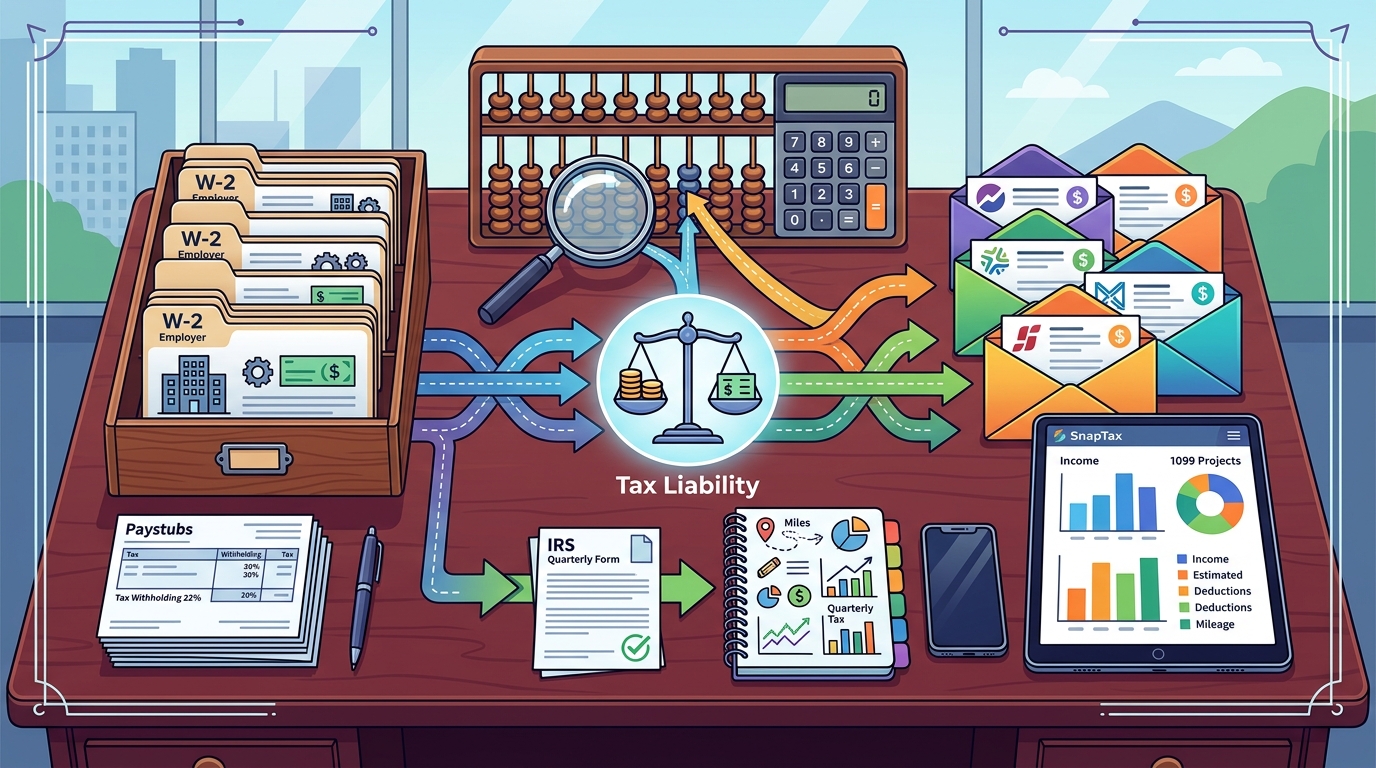
When you earn income from both a W-2 job and 1099 freelance work, you are essentially operating as two different taxpayers simultaneously. Your W-2 employer withholds federal income tax, Social Security, and Medicare from your paycheck. However, your 1099 income has no automatic withholding. This discrepancy creates a gap in your tax coverage that must be filled manually. (SnapTax Freelancer Tax Planning)
Self-employment tax is a critical component of this burden. Self-employment tax is a federal tax that covers Social Security and Medicare contributions for independent contractors. Unlike W-2 employees who split this cost with their employer, 1099 workers must pay the entire 15.3% themselves. This tax applies to net earnings from self-employment, meaning you only pay it on the profit after deducting legitimate business expenses. (SnapTax Freelancer Tax Planning)
Many hybrid earners make the mistake of ignoring their 1099 income until April. By then, interest and penalties can accumulate rapidly. The IRS expects taxpayers to pay their tax liability as they earn income throughout the year. Failing to do so results in underpayment penalties that can erode your hard-earned freelance profits. Understanding the mechanics of this burden is the first step toward avoiding costly mistakes. (SnapTax Freelancer Tax Planning)
Self-Employment Tax Explained
The concept of self-employment tax often confuses new freelancers. It is distinct from regular income tax. While income tax is based on your total taxable income and filing status, self-employment tax is a flat rate applied to your net business profit. This tax funds the Social Security and Medicare programs that you would otherwise receive through your W-2 employer.
Calculating this tax requires accurate bookkeeping. You must track all business-related expenses to reduce your net profit. Net profit is the amount of money left after subtracting business expenses from your gross freelance income. For example, if you earn $50,000 from freelance work and have $10,000 in deductible expenses, your net profit is $40,000. You would pay the 15.3% self-employment tax on the $40,000, not the full $50,000.
Additionally, you can deduct the employer-equivalent portion of your self-employment tax when calculating your adjusted gross income. This deduction reduces your overall income tax liability, providing a slight offset to the heavy tax burden. However, it does not eliminate the self-employment tax itself. Properly tracking these figures is essential for maximizing your tax efficiency.
Quarterly Payment Strategies
One of the most significant pitfalls for hybrid earners is failing to make estimated tax payments. The IRS requires taxpayers to pay at least 90% of the current year's tax or 100% of the prior year's tax (110% if your adjusted gross income exceeds $150,000) through withholding or estimated payments. If you fall short, you face penalties.
Quarterly estimated taxes are due on April 15, June 15, September 15, and January 15 of the following year. These payments cover both your income tax and self-employment tax liabilities. For hybrid earners, the challenge lies in estimating the correct amount. You must project your total annual income from both sources and calculate the resulting tax liability.
Using a dedicated tax planning tool can simplify this process. Estimated tax payments are mandatory quarterly contributions to the IRS to avoid underpayment penalties. SnapTax helps freelancers track income and deductions in real-time, providing accurate projections for these payments. By entering your W-2 withholding information and your freelance income throughout the year, the software calculates exactly how much you need to pay each quarter.
Ignoring these deadlines is a common error. The penalties for late payment can be steep, compounding over time. By staying ahead of your quarterly obligations, you maintain cash flow stability and avoid the stress of a large tax bill in April. Consistent quarterly payments also help you avoid the "tax shock" that many freelancers experience when filing their annual return.
Deduction Optimization for Hybrid Earners
Maximizing deductions is crucial for reducing your taxable income. Hybrid earners have access to a wide range of deductions that can significantly lower their tax bill. However, these deductions must be strictly related to your 1099 work. Personal expenses cannot be claimed as business deductions.
Common deductions for freelancers include home office expenses, internet and phone bills, software subscriptions, and professional development costs. If you use a portion of your home exclusively for business, you may qualify for the home office deduction. This can be calculated using the simplified method or the regular method, depending on your specific situation.
Another powerful deduction is the Qualified Business Income (QBI) deduction. This provision allows eligible taxpayers to deduct up to 20% of their qualified business income from their taxes. However, there are income limits and specific rules that apply. Understanding these rules is essential for claiming this deduction correctly.
Asset depreciation is another area where hybrid earners can save money. If you purchase equipment or vehicles for your freelance work, you may be able to deduct a portion of the cost. Asset depreciation is the allocation of the cost of a tangible asset over its useful life for tax purposes. Tools like SnapTax automate this process, ensuring you capture every eligible deduction without manual calculation errors.
Planning and Comparison
Effective tax planning requires comparing different strategies to determine the best approach for your specific financial situation. Hybrid earners must weigh the benefits of withholding additional taxes from their W-2 paycheck against making quarterly estimated payments.
| Strategy | Pros | Cons | Best For |
|---|---|---|---|
| W-2 Withholding Adjustment | Automatic, no quarterly deadlines | Less control over cash flow, may over-withhold | Stable freelance income |
| Quarterly Estimated Payments | Pays tax as earned, avoids penalties | Requires manual tracking, strict deadlines | Variable freelance income |
| Tax Planning Software | Real-time projections, automated calculations | Subscription cost | All hybrid earners |
Choosing the right strategy depends on your income stability and risk tolerance. If your freelance income is unpredictable, quarterly payments may be safer. If your W-2 job is your primary income source, adjusting your withholding might be sufficient. However, combining both strategies often provides the best balance of compliance and cash flow management.
Regularly reviewing your tax status is essential. Life changes, such as marriage, children, or a shift in freelance work, can impact your tax bracket and deductions. Staying informed about tax law changes ensures you remain compliant and optimized. Resources from the IRS provide valuable guidance on these evolving regulations.
Key Takeaways
- Hybrid earners must pay the full 15.3% self-employment tax on net freelance profit.
- Quarterly estimated tax payments are mandatory to avoid IRS underpayment penalties.
- Net profit is calculated by subtracting business expenses from gross freelance income.
- The Qualified Business Income (QBI) deduction can reduce taxable income by up to 20%.
- Asset depreciation allows for the deduction of equipment and vehicle costs over time.
- Real-time tax tracking tools help hybrid earners stay compliant and avoid surprises.
- Adjusting W-2 withholding can supplement quarterly payments for better cash flow.
Frequently Asked Questions
How do I calculate my estimated tax payments?
To calculate your estimated tax payments, you must estimate your total annual income from both W-2 and 1099 sources. Subtract any deductions and credits, then apply the appropriate tax rates. Divide the resulting tax liability by four to determine each quarterly payment. Using tax planning software can automate this calculation for accuracy.
Can I deduct home office expenses if I work from home?
Yes, you can deduct home office expenses if you use a portion of your home exclusively and regularly for business. The IRS offers two methods: the simplified option, which deducts $5 per square foot, and the regular method, which calculates the actual percentage of home expenses used for business.
What happens if I miss a quarterly tax deadline?
If you miss a quarterly tax deadline, the IRS will charge a penalty for late payment. The penalty is calculated based on the amount owed and the number of days late. It is crucial to pay as much as possible by the deadline to minimize these penalties.
Do I need to pay self-employment tax on my W-2 income?
No, you do not pay self-employment tax on your W-2 income. Your W-2 employer withholds Social Security and Medicare taxes from your paycheck. Self-employment tax only applies to your net earnings from 1099 freelance work.
How does the QBI deduction work for hybrid earners?
The QBI deduction allows eligible taxpayers to deduct up to 20% of their qualified business income from their taxes. For hybrid earners, this deduction applies to the net profit from their 1099 work. There are income limits and specific rules that may affect eligibility, so consulting a tax professional is recommended.
Can I use SnapTax to track both W-2 and 1099 income?
SnapTax is designed to help freelancers track 1099 income and expenses. While it does not directly manage W-2 withholding, it helps you calculate the total tax liability from your freelance work, which informs how much you need to pay via estimated taxes or adjust in your W-2 withholding.
What is the deadline for filing annual taxes as a hybrid earner?
The deadline for filing annual taxes is typically April 15 of the following year. However, you can request an extension to file until October 15. Note that an extension to file does not extend the deadline to pay any taxes owed, so estimated payments are still required by the original deadlines.
Start Your Tax Planning
Combining W-2 and 1099 income offers significant financial opportunities, but it requires diligent tax management to avoid pitfalls. By understanding self-employment tax, making timely quarterly payments, and maximizing deductions, you can keep more of your hard-earned money. SnapTax provides the tools you need to track income, calculate liabilities, and stay compliant throughout the year. Start your free trial today and take control of your hybrid tax strategy.