

Managing a hybrid income stream is one of the most common financial challenges for modern professionals. According to recent labor market data, the number of Americans earning income from both traditional employment and freelance work has grown significantly, with many households now relying on this dual-income structure to maintain financial stability. However, mixing these two distinct types of earnings creates a complex tax filing environment that often leads to costly errors. When you receive both a W-2 form from an employer and 1099 forms from clients, the IRS expects you to navigate two different sets of rules simultaneously. Failing to understand how these forms interact can result in underpayment penalties, missed deductions, and unnecessary stress during tax season. (2024 State Income) (SnapTax Freelancer Tax Planning)
Understanding the Basics of Mixed Income
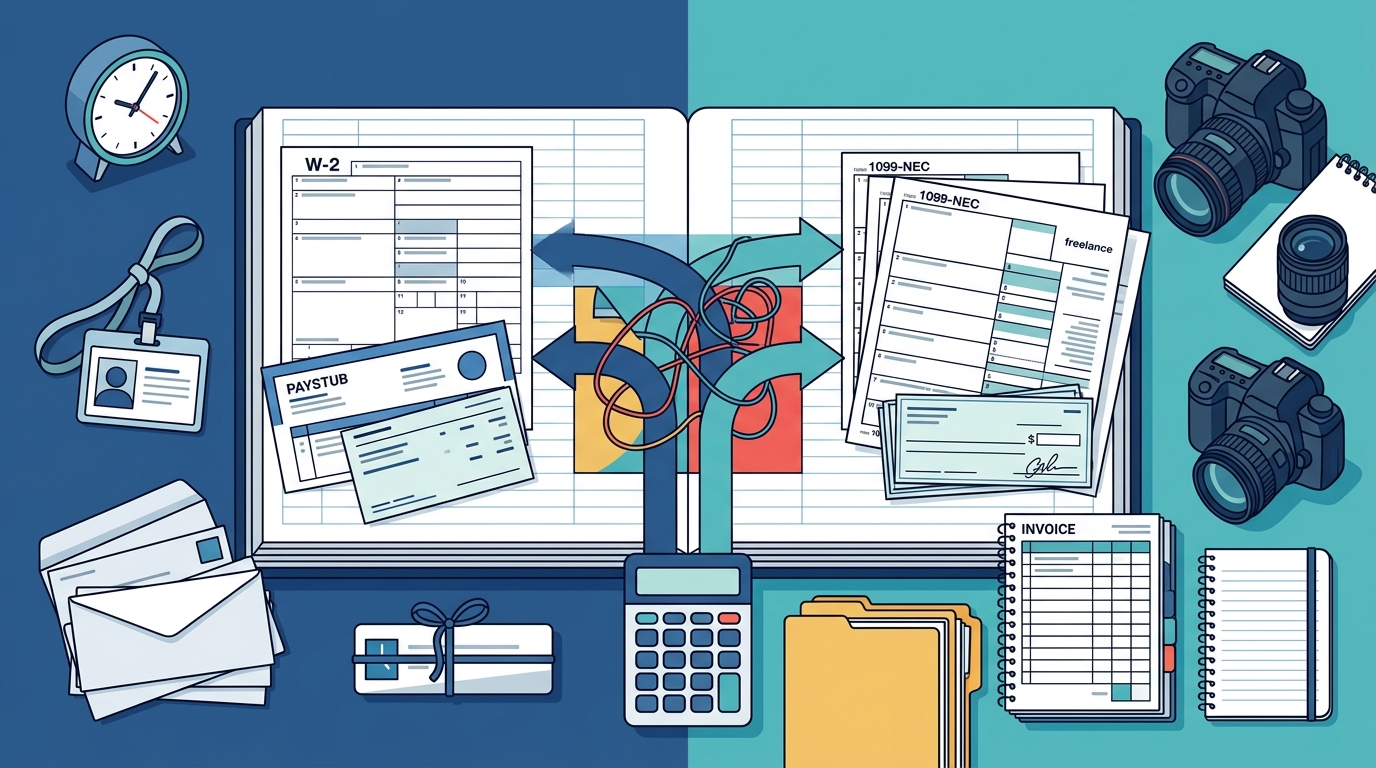
To file correctly, you must first distinguish between the two primary types of income. W-2 income is wages earned from an employer who withholds taxes automatically. 1099 income is self-employment earnings from clients or gig platforms where no taxes are withheld. This distinction is critical because the tax treatment differs fundamentally. W-2 employees have their federal income tax, Social Security, and Medicare taxes taken out of every paycheck. Freelancers, however, are responsible for calculating and paying these taxes themselves throughout the year. (2024 State Income)
When you combine these streams, your total tax liability does not simply add up linearly. The IRS uses a progressive tax bracket system, meaning your combined income could push you into a higher marginal tax rate. Additionally, the self-employment tax applies only to the 1099 portion of your income, but it is calculated separately from your regular income tax. Many filers mistakenly apply the self-employment tax rate to their entire income, leading to overpayment, or they ignore it entirely, leading to underpayment. Understanding this separation is the first step toward accurate filing.
Self-Employment Tax Pitfalls
The most significant error mixed-income earners make is miscalculating the self-employment tax. This tax covers Social Security and Medicare contributions for independent contractors. The standard rate is 15.3%, which consists of 12.4% for Social Security and 2.9% for Medicare. Unlike W-2 employees who split this cost with their employer, freelancers pay the full 15.3% on their net self-employment income.
A common mistake is failing to account for the deductible portion of this tax. You can deduct half of your self-employment tax from your adjusted gross income, which reduces your overall taxable income. However, this deduction only applies to the self-employment portion, not your W-2 wages. If you are using basic tax software that does not automatically separate these calculations, you might miss this deduction. SnapTax handles this complexity by automatically calculating your self-employment tax liability and identifying the deductible portion, ensuring you do not overpay or underpay.
Another pitfall involves the income threshold for the Social Security portion. The 12.4% Social Security tax only applies to income up to a specific annual limit, which changes yearly. Once your combined W-2 and 1099 income exceeds this cap, you stop paying the Social Security portion but continue paying the Medicare portion. Failing to track this cap can lead to incorrect tax estimates. Using a tool like SnapTax's 1099 Tax Calculator helps you monitor your earnings against these thresholds in real time.
Common Deduction Errors
Freelancers have access to a wider range of deductions than W-2 employees, but this advantage comes with strict documentation requirements. One major error is commingling personal and business expenses. If you use a single bank account for both your freelance work and personal life, it becomes nearly impossible to prove which expenses are business-related. The IRS requires clear separation to validate deductions for home office use, internet bills, and professional supplies.
Another frequent mistake is neglecting the home office deduction. To claim this, your home office must be used exclusively and regularly for business. Many mixed-income earners work from home part-time for their W-2 job and part-time for their 1099 clients, which can complicate this claim. If you use a space for both, you must prorate the deduction based on the percentage of time and square footage used for business. SnapTax's Asset Depreciation Tax Deductions guide and built-in tools help you accurately calculate these percentages without manual spreadsheet errors.
Receipt management is also a critical area where errors occur. Freelancers often save receipts in a shoebox or a disorganized digital folder, only to lose them before tax season. Without proper documentation, the IRS can disallow these deductions, increasing your taxable income. SnapTax's AI-powered receipt management allows you to snap photos of receipts, which are then automatically categorized and stored. This ensures that every deductible expense is tracked and ready for audit defense.
Quarterly Payment Miscalculations
One of the most financially damaging mistakes is failing to make timely quarterly estimated tax payments. The IRS requires taxpayers who expect to owe $1,000 or more in tax after subtracting withholding and credits to pay estimated taxes quarterly. For mixed-income earners, this is tricky because your W-2 withholding might not cover your self-employment tax liability.
Many freelancers assume their W-2 withholding is sufficient, only to face a large bill and penalties in April. The safe harbor rule allows you to avoid penalties if you pay 90% of the current year's tax or 100% of the prior year's tax. However, calculating this correctly requires knowing your total projected income from both sources. SnapTax provides real-time quarterly tax estimates that adjust as your income changes, helping you stay compliant with IRS deadlines. You can learn more about avoiding IRS quarterly tax penalties by using proactive planning tools.
Another error is underestimating your state tax liability. While federal taxes are standardized, state tax rates and rules vary significantly. Some states have no income tax, while others have high rates and specific deductions for freelancers. Failing to account for your state's requirements can lead to unexpected local tax bills. SnapTax calculates state tax liabilities for all 50 states, ensuring you set aside the correct amount for your jurisdiction.
Choosing the Right Tax Software
Not all tax software is created equal when it comes to mixed income. Standard W-2 focused software often lacks the depth needed for Schedule C filings. It may not handle self-employment tax calculations, asset depreciation, or complex deduction categorization accurately. This is where specialized tools like SnapTax become essential.
| Feature | Standard W-2 Software | SnapTax (Freelancer Focused) |
|---|---|---|
| Self-Employment Tax Calculation | Limited or Manual | Automatic and Accurate |
| 1099 Income Tracking | Basic Entry | AI-Powered Categorization |
| Quarterly Tax Estimates | Not Available | Real-Time Projections |
| Receipt Management | Manual Upload | OCR and Auto-Categorization |
| TurboTax Export | N/A | One-Click TXF Export |
SnapTax is designed specifically for freelancers and 1099 workers. It offers a free plan that includes quarterly tax estimates and a saved tax profile, making it accessible for those just starting out. For more advanced needs, the Builder and Optimizer plans provide bank statement uploads, AI expense categorization, and detailed profit and loss reports. This tiered approach ensures you only pay for the features you need, whether you are a side-hustler or a full-time independent contractor.
Key Takeaways
- Separate Your Finances: Keep business and personal accounts distinct to simplify tracking and audit defense.
- Pay Quarterly Taxes: Use SnapTax to calculate and track estimated payments to avoid IRS penalties.
- Track All Deductions: Document home office, mileage, and supply expenses meticulously to maximize savings.
- Understand Self-Employment Tax: Remember the 15.3% rate and the deductible half for net income.
- Use Specialized Software: Choose tools like SnapTax that handle both W-2 and 1099 complexities seamlessly.
- Monitor Income Caps: Be aware of Social Security tax caps to avoid overpayment.
- Export for Professionals: Use TXF export features if you work with a CPA for final filing.
Frequently Asked Questions
Can I deduct home office expenses if I also work from home for my W-2 job?
You can only deduct home office expenses for the portion of the home used exclusively for your 1099 business. If you use the space for both, you must prorate the deduction based on square footage and time used for business purposes.
How do I calculate self-employment tax on mixed income?
Self-employment tax is calculated only on your net 1099 income, not your W-2 wages. You file Schedule SE to determine this amount, which is then added to your income tax liability. SnapTax automates this calculation for you.
What happens if I underpay my quarterly taxes?
If you underpay, the IRS may charge interest and penalties. Using SnapTax's real-time estimates helps you adjust your payments throughout the year to stay within the safe harbor limits and avoid these fees.
Can I use SnapTax if I have multiple 1099 clients?
Yes, SnapTax allows you to track income from multiple sources and categorize expenses by client or project, making it easy to manage complex freelance portfolios.
Is SnapTax compatible with TurboTax?
Yes, SnapTax offers a one-click TXF export feature that allows you to import your Schedule C data directly into TurboTax, streamlining the final filing process.
Do I need to pay estimated taxes if I have W-2 withholding?
Yes, if your total tax liability after withholding is $1,000 or more, you are required to pay estimated taxes. Your W-2 withholding may not cover your self-employment tax obligations.
How does SnapTax handle state taxes?
SnapTax calculates state tax liabilities for all 50 states, applying the correct rates and standard deductions for your specific jurisdiction to ensure accurate quarterly estimates.
Get Started with SnapTax
Stop guessing your tax liability and start taking control of your finances. SnapTax provides the tools you need to track income, manage deductions, and plan for quarterly payments with confidence. Whether you are a freelancer, gig worker, or independent contractor, our platform is designed to simplify your tax journey. Start your free preview today and see how SnapTax can help you file accurately and efficiently.