

Missing a tax deadline is one of the most common financial mistakes independent contractors make. The Internal Revenue Service expects self-employed individuals to pay their taxes throughout the year rather than in one lump sum. If you fail to meet these obligations, the IRS imposes underpayment penalties that can quickly erode your profits. According to recent IRS data, millions of taxpayers face these avoidable fees annually due to miscalculated estimates or missed deadlines. This guide explains exactly how to stay compliant and keep your money. (SnapTax Freelancer Tax Planning)
Understanding the Quarterly Tax Requirement
Self-employment tax is a social insurance program that funds Social Security and Medicare. Unlike traditional employees, where employers withhold these taxes from every paycheck, freelancers must handle this themselves. This system is known as the estimated tax system. Estimated tax is the method the IRS uses to collect tax on self-employment income. (SnapTax Freelancer Tax Planning)
If you expect to owe at least $1,000 in tax for the current year after subtracting withholding and credits, you generally must pay estimated tax. The IRS requires these payments to be made in four installments. This structure ensures that the government receives revenue steadily throughout the fiscal year. It also prevents freelancers from facing a massive tax bill in April that they cannot pay. (SnapTax Freelancer Tax Planning)
Failure to pay enough tax through these quarterly installments results in an underpayment penalty. This penalty is essentially interest charged by the government for using their money instead of paying it on time. Avoiding this penalty requires proactive planning and accurate tracking of your financial status. (SnapTax Freelancer Tax Planning)
Calculating Your Exact Tax Obligation
One of the biggest challenges for freelancers is determining how much to set aside. You cannot simply guess this number. You must calculate your taxable income by subtracting allowable business deductions from your gross income. Net profit is the total revenue minus allowable business expenses.
Your tax liability consists of two main parts. First, you owe income tax on your net profit. Second, you owe self-employment tax, which is currently 15.3%. This covers Social Security and Medicare contributions. The IRS uses specific tax brackets to determine your income tax rate. These brackets change periodically based on inflation and legislative updates.
To estimate your quarterly payment, you can use the following formula:
- Calculate your expected annual net profit.
- Apply the appropriate tax rates to determine total tax liability.
- Subtract any tax already withheld from other sources.
- Divide the remaining amount by four.
Tools like SnapTax automate this complex calculation. The software uses current IRS tables to project your liability in real time. This eliminates the need for manual spreadsheet math and reduces the risk of human error. You can view your projected annual tax owed at any moment, allowing you to adjust your savings strategy immediately.
Tracking Income and Expenses Accurately
Accurate record-keeping is the foundation of tax compliance. If you cannot prove your expenses, you cannot deduct them. This leads to a higher taxable income and a larger tax bill. Freelancers often lose thousands of dollars annually by failing to document deductible expenses properly.
Key deductible expenses include home office costs, internet and phone bills, software subscriptions, and professional development. Mileage is another significant deduction. The IRS allows you to deduct a standard mileage rate for business-related driving. This rate is adjusted annually to reflect the cost of operating a vehicle.
Manual tracking is prone to errors and omissions. Using dedicated software ensures that every transaction is categorized correctly. SnapTax offers AI-powered expense categorization that sorts your bank transactions into Schedule C categories automatically. This feature saves hours of manual data entry and ensures that no deductible expense is overlooked.
Receipt management is also critical. You must retain proof of every business purchase. SnapTax allows you to snap photos of receipts or forward them via email. The software uses optical character recognition to extract the vendor, amount, and date. This creates an audit-ready digital trail that simplifies your year-end filing process.
Knowing Your Quarterly Deadlines
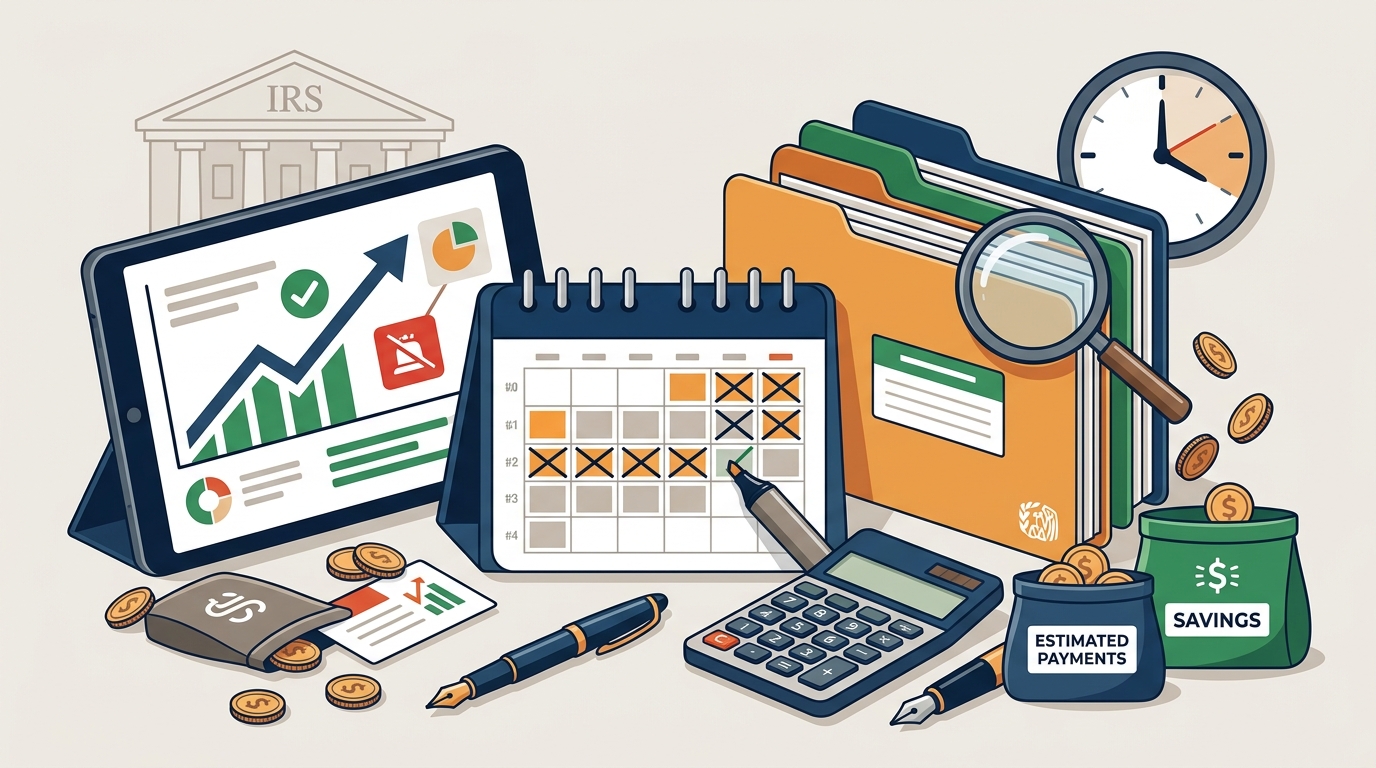
The IRS sets strict deadlines for estimated tax payments. Missing these dates triggers the underpayment penalty. The four quarterly due dates are:
- April 15: First quarter payment.
- June 15: Second quarter payment.
- September 15: Third quarter payment.
- January 15: Fourth quarter payment of the following year.
If a due date falls on a weekend or a legal holiday, the payment is considered timely if made on the next business day. However, relying on this rule is risky. It is always safer to pay a few days early. SnapTax tracks these deadlines and sends you reminders before each payment is due. This proactive approach ensures that you never miss a window for payment.
Understanding these dates is vital for cash flow management. Freelancers often have irregular income streams. Planning your payments around these fixed dates helps you avoid liquidity crunches. You can set aside funds gradually throughout the quarter to ensure you have the cash available when the deadline arrives.
Making Payments Correctly
The IRS provides several methods for paying estimated taxes. The most common method is the Electronic Federal Tax Payment System (EFTPS). This free service allows you to make payments online or by phone. It provides immediate confirmation of your payment, which is essential for your records.
Another option is paying by credit or debit card through an authorized payment processor. While convenient, this method often involves a processing fee. For freelancers operating on tight margins, these fees can add up over four payments a year. EFTPS remains the most cost-effective option for most users.
SnapTax simplifies the payment process by providing clear instructions and direct links to the IRS payment portals. The software also keeps a full payment history. This record is invaluable if the IRS ever questions your payment status. It provides undeniable proof that you met your obligations on time.
Strategies to Avoid Penalties
There are specific strategies you can use to minimize or eliminate underpayment penalties. The most effective method is paying the correct amount each quarter. This requires accurate income projection and timely expense tracking. If your income fluctuates significantly, you may need to adjust your payment amounts mid-year.
Another strategy is the annualization method. If your income is seasonal, you can calculate your payments based on the income earned in each specific period. This can result in lower payments during low-income months. However, this method is complex and requires careful calculation. Using software that supports seasonal projections can make this process manageable.
You can also avoid penalties by ensuring your total annual tax payment meets certain thresholds. If you pay at least 90% of the current year's tax or 100% of the prior year's tax, you may be exempt from penalties. This safe harbor rule is particularly useful for freelancers whose income increases significantly from one year to the next. SnapTax helps you monitor these thresholds in real time, ensuring you stay within the safe limits.
Key Takeaways
- Self-employed individuals must pay estimated taxes four times a year to avoid penalties.
- The self-employment tax rate is 15.3%, covering Social Security and Medicare.
- Quarterly deadlines are April 15, June 15, September 15, and January 15.
- Accurate expense tracking is essential for lowering your taxable income.
- Using tax software like SnapTax automates calculations and deadline tracking.
- Paying 90% of the current year's tax or 100% of the prior year's tax can waive penalties.
- Electronic payments via EFTPS are free and provide immediate confirmation.
Frequently Asked Questions
What is the penalty for missing a quarterly tax payment?
The penalty is calculated based on the amount underpaid and the number of days it is late. The IRS charges interest on the unpaid amount. The rate changes quarterly. It is crucial to pay as soon as possible to minimize these costs.
Can I avoid quarterly taxes if I have a W-2 job?
If you have a W-2 job, your employer withholds taxes. You may not need to pay estimated taxes if your total withholding covers your tax liability. However, if you have significant side income, you likely still need to make quarterly payments.
How does SnapTax help avoid penalties?
SnapTax provides real-time tax projections and tracks your payments against IRS deadlines. It alerts you when you are at risk of underpayment and helps you calculate the exact amount needed to stay compliant.
What happens if I underpay my estimated taxes?
You will owe an underpayment penalty when you file your annual return. This penalty is added to your tax bill. It is not a one-time fee but an interest charge that accumulates over time.
Are business expenses deductible from quarterly payments?
Yes, you can deduct business expenses from your gross income to determine your taxable income. This reduces the amount you owe each quarter. Keeping accurate records of these expenses is vital.
Can I pay my estimated taxes online?
Yes, the IRS offers the Electronic Federal Tax Payment System (EFTPS) for online payments. You can also use authorized third-party processors, though they may charge fees.
What is the safe harbor rule for tax penalties?
The safe harbor rule allows you to avoid penalties if you pay at least 90% of the current year's tax or 100% of the prior year's tax through withholding and estimated payments.
Start Protecting Your Finances Today
Avoiding quarterly tax penalties requires diligence, accuracy, and the right tools. Manual tracking is error-prone and time-consuming. SnapTax offers a comprehensive solution for freelancers and 1099 workers. Our software automates income tracking, expense categorization, and tax projection. You can start with our free trial to see how SnapTax simplifies your tax life. Visit SnapTax now to take control of your financial future and ensure you never owe a penalty again.