

What Tax Deductions Can Self-Employed People Claim in 2026?
Self-employment tax compliance has become increasingly complex for independent contractors and gig workers. According to recent IRS data, the self-employment tax rate remains fixed at 15.3% for 2026, applying to net earnings from self-employment. This rate combines Social Security and Medicare taxes, creating a significant financial burden for those without employer contributions. Understanding which expenses are deductible is critical for reducing your taxable income and avoiding underpayment penalties. This guide details the specific deductions available to 1099 workers in the current tax year. (SnapTax Freelancer Tax Planning)
The Home Office Deduction
One of the most valuable deductions for remote workers is the home office expense. The IRS allows you to deduct expenses related to the part of your home used exclusively and regularly for business. This is not just for full-time offices; even a dedicated desk in a spare room can qualify if it serves as your principal place of business.
There are two methods to calculate this deduction: the simplified option and the regular method. The simplified option allows you to deduct $5 per square foot of your home office space, up to 300 square feet. The regular method requires you to track actual expenses like mortgage interest, rent, utilities, and insurance, allocating a percentage based on your office size relative to your total home.
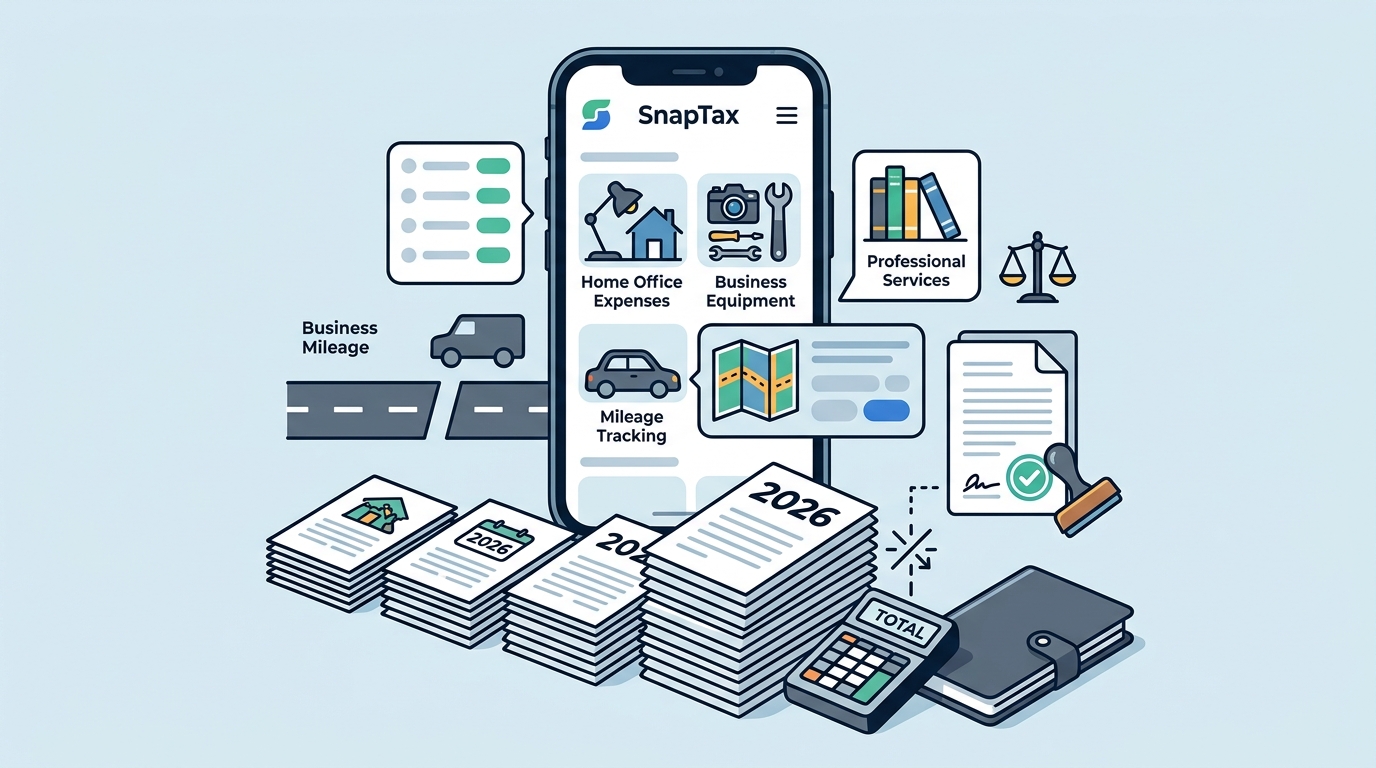
SnapTax simplifies this process by automatically tracking your business mileage and helping you categorize home-related expenses if you upload your bank statements. SnapTax ensures you do not miss out on this significant deduction by keeping a clear audit trail of your business use.
Mileage and Business Travel
For freelancers who drive for work, the standard mileage rate is a powerful deduction tool. In 2026, the IRS standard mileage rate for business use is set to reflect current fuel and maintenance costs. Using this rate allows you to deduct the cost of operating your vehicle without keeping receipts for every gallon of gas or oil change.
It is crucial to distinguish between business miles and personal miles. Only miles driven to meet clients, pick up supplies, or attend business-related events count. Commuting from your home to your regular workplace does not qualify. However, if you work from home, driving to a client's site is considered business mileage.
SnapTax features a GPS-based mileage tracker that automatically logs your business trips with IRS-compliant audit logs. This eliminates the guesswork and ensures you have the necessary documentation in case of an audit. Track your business mileage effortlessly with SnapTax to maximize your deductions.
Technology and Software Expenses
In the digital economy, technology is the backbone of most freelance businesses. You can deduct the cost of computers, peripherals, and software subscriptions that are used primarily for business. This includes everything from your laptop and smartphone to cloud storage services and project management tools.
For larger equipment purchases, you may be eligible for Section 179 deductions or bonus depreciation. These provisions allow you to deduct the full purchase price of qualifying equipment and software purchased or financed in 2026. This can significantly reduce your taxable income in the year of purchase.
SnapTax includes an asset depreciation tracker that handles Section 179 and bonus depreciation calculations automatically. By logging your equipment purchases in the app, you ensure that you capture these high-value deductions without complex manual calculations. Learn more about asset depreciation for freelancers to understand how to maximize your tech deductions.
Health Insurance Premiums
Unlike traditional employees, self-employed individuals must purchase their own health insurance. The good news is that you can deduct 100% of your health insurance premiums for yourself, your spouse, and your dependents. This deduction is taken "above the line," meaning it reduces your adjusted gross income (AGI) even if you do not itemize deductions.
To qualify, you must have net profit from your business. If your business shows a loss, you may not be able to take this deduction for that year. It is important to keep records of your insurance payments and policies to substantiate this claim.
While SnapTax does not directly process health insurance payments, it helps you track your overall financial health and net profit. By accurately tracking your income and other expenses, SnapTax ensures your net profit is calculated correctly, which is the prerequisite for claiming this deduction. IRS guidelines on health insurance deductions provide further details on eligibility.
Retirement Contributions
Planning for retirement is essential for self-employed workers. Contributions to self-employed retirement plans, such as a SEP-IRA, SIMPLE IRA, or Solo 401(k), are tax-deductible. These contributions reduce your taxable income for the year, allowing your money to grow tax-deferred.
The contribution limits for 2026 are higher than previous years, allowing you to save more and reduce your tax bill simultaneously. For example, a Solo 401(k) allows for both employee and employer contributions, providing a substantial tax shelter for high-earning freelancers.
SnapTax's Optimizer plan includes retirement tracking features that help you monitor your contributions and ensure you stay within IRS limits. By integrating your retirement planning with your tax tracking, you can optimize your overall financial strategy. Fidelity's guide to self-employed retirement plans offers comprehensive advice on choosing the right account.
Professional Services and Education
Expenses related to running your business professionally are also deductible. This includes fees paid to accountants, lawyers, and contractors. If you hire a virtual assistant or a freelance graphic designer, those payments are fully deductible as business expenses.
Education expenses are another category to consider. You can deduct the cost of courses, workshops, and seminars that maintain or improve skills required in your current trade. However, expenses for education that qualifies you for a new trade or profession are not deductible.
SnapTax's AI expense categorization can help you sort these transactions automatically. By uploading your bank statements, the app identifies payments to professional services and categorizes them correctly, saving you time and reducing errors. IRS Publication 334 details the rules for business deductions.
Key Takeaways
- The self-employment tax rate for 2026 remains at 15.3%, making deductions critical for reducing taxable income.
- The home office deduction can save thousands for remote workers, with options for simplified or regular calculation methods.
- SnapTax's GPS mileage tracker provides IRS-compliant logs, ensuring accurate deduction of business travel expenses.
- Section 179 and bonus depreciation allow for immediate deduction of large equipment purchases in the year they are bought.
- Health insurance premiums are fully deductible for self-employed individuals, provided they have net business profit.
- Retirement contributions to SEP-IRAs or Solo 401(ks) offer significant tax benefits and future security.
- SnapTax's AI categorization and TurboTax export features streamline the entire tax preparation process for freelancers.
Frequently Asked Questions
What is the standard mileage rate for 2026?
The standard mileage rate for business use in 2026 is determined by the IRS annually. SnapTax updates its calculations automatically to reflect the current rate, ensuring your deductions are accurate without manual updates.
Can I deduct my home internet bill as a freelancer?
Yes, you can deduct a portion of your home internet bill if you use your home office for business. The percentage deducted should correspond to the percentage of your internet usage that is business-related.
How does SnapTax help with quarterly tax estimates?
SnapTax calculates your real-time federal and state tax liability throughout the year. It provides projected quarterly payment amounts based on your current income and deductions, helping you avoid underpayment penalties.
What is the difference between a SEP-IRA and a Solo 401(k)?
A SEP-IRA is simpler to set up and has higher contribution limits based on a percentage of your income. A Solo 401(k) allows for both employee and employer contributions, potentially offering higher total savings for high earners.
Can I deduct the cost of my laptop if I use it for both personal and business?
Yes, you can deduct the portion of the cost attributable to business use. If you use it 80% for business, you can deduct 80% of the cost. SnapTax's asset tracker helps you log these purchases and calculate the depreciation.
Do I need to itemize deductions to claim the home office deduction?
No, the home office deduction is an above-the-line deduction. You can take it whether you itemize or take the standard deduction. SnapTax helps you calculate this deduction accurately regardless of your filing status.
How do I export my data to TurboTax?
SnapTax allows you to export your Schedule C data in TXF format. This file can be imported directly into TurboTax, making the transition from tracking to filing seamless and error-free.
Start Optimizing Your Taxes Today
Don't leave money on the table. With SnapTax, you can track income, deductions, and mileage in one place, ensuring you claim every deduction you are entitled to in 2026. Book a demo or start your free trial today to take control of your freelance finances.