

Managing a hybrid income stream is one of the most common financial challenges for modern professionals. According to recent labor market data, nearly 20% of the US workforce now engages in some form of freelance or gig work alongside traditional employment. This dual status creates a unique tax landscape where standard withholding rules no longer apply to your entire earnings picture. Without proactive planning, you risk significant underpayment penalties and cash flow surprises when April arrives. (SnapTax Freelancer Tax Planning)
Understanding the Basics of Dual Income
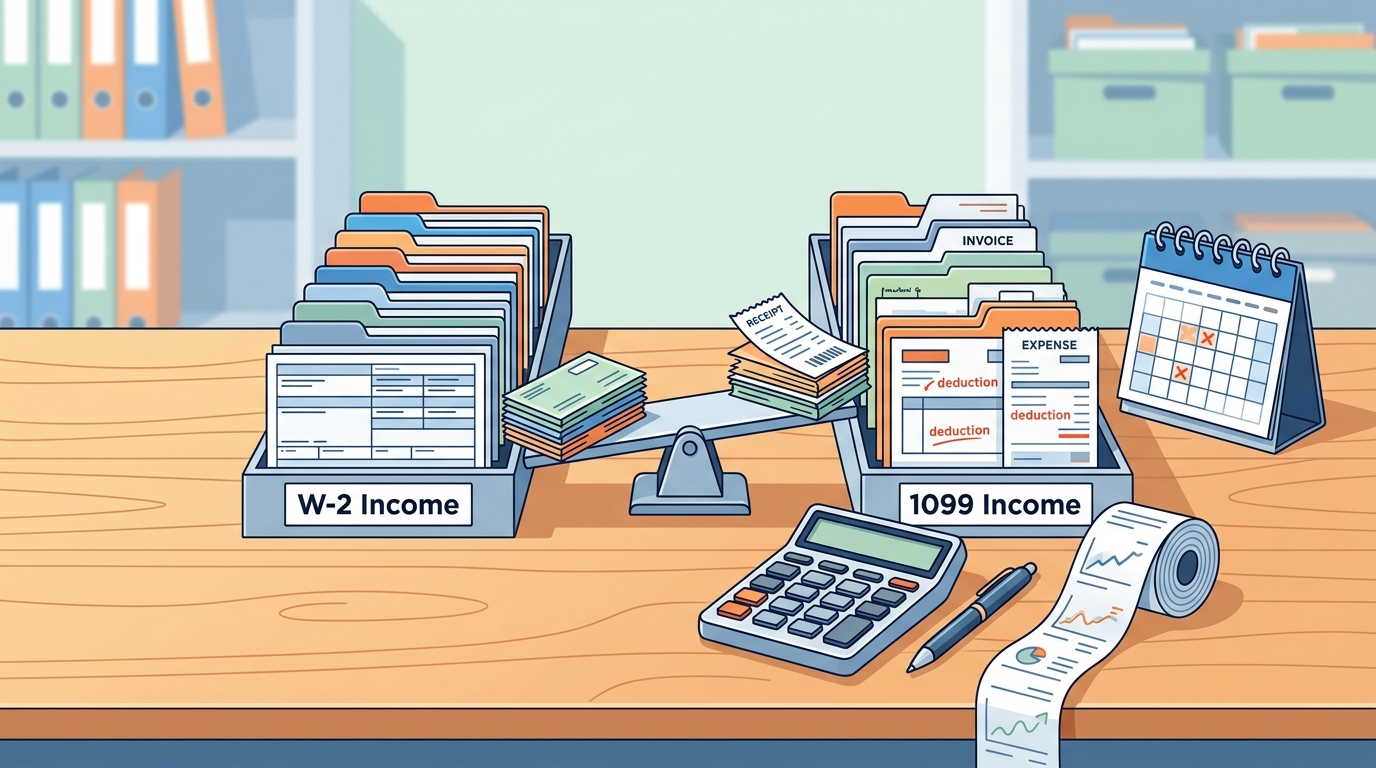
When you hold both a W-2 job and a 1099 side hustle, you are essentially two different taxpayers in the eyes of the IRS. Your W-2 employer acts as a withholding agent, deducting federal income tax, Social Security, and Medicare from your paycheck. In contrast, your 1099 income is treated as self-employment income. This means no taxes are withheld at the source. You are responsible for calculating and paying these taxes yourself throughout the year.
Self-employment tax is a critical component often overlooked by dual-income earners. This tax funds Social Security and Medicare for independent contractors. For 2026, the self-employment tax rate remains at 15.3% of your net earnings. This rate applies to the first $168,600 of net income, with additional Medicare tax applying to earnings above that threshold. Understanding this baseline is essential for accurate budgeting.
The Withholding Gap and Quarterly Taxes
The primary friction point for dual-income earners is the "withholding gap." Your W-2 withholding is calculated based solely on your employment wages. It does not account for the additional tax liability generated by your freelance work. If you ignore this gap, you will likely face an underpayment penalty when you file your annual return.
To avoid penalties, the IRS requires estimated quarterly tax payments. These payments are due on April 15, June 15, September 15, and January 15 of the following year. The amount you owe each quarter is based on your expected annual income from both sources. You must combine your W-2 withholding with your projected 1099 tax liability to determine the correct payment amount.
Many freelancers make the mistake of paying taxes only on their freelance income. This is incorrect. You must look at your total household tax liability. If your W-2 withholding is insufficient to cover the combined tax burden, you must increase your quarterly payments. Conversely, if your W-2 withholding is high, you might need to adjust your W-4 form to reduce withholding, improving your monthly cash flow.
Maximizing Deductions for 1099 Work
One of the most significant advantages of having 1099 income is the ability to deduct business expenses. These deductions reduce your net self-employment income, which in turn lowers both your income tax and your self-employment tax liability. Common deductions include home office expenses, software subscriptions, marketing costs, and professional development.
Asset depreciation is another powerful tool for freelancers. If you purchase equipment such as computers, cameras, or vehicles for business use, you can deduct a portion of the cost. SnapTax handles Section 179 and bonus depreciation automatically, ensuring you capture every eligible deduction without complex manual calculations. This feature is particularly valuable for those investing in high-value assets to support their side business.
Mileage tracking is another critical area. If you use your personal vehicle for business purposes, you can deduct either the standard mileage rate or actual expenses. GPS-based tracking provides an audit-proof log of your business miles, simplifying the process and reducing the risk of errors during tax season. Accurate mileage logs can save thousands of dollars for freelancers who travel frequently for client meetings or site visits.
Navigating Self-Employment Tax
Self-employment tax is often the most surprising cost for new freelancers. Unlike W-2 employees who split the Social Security and Medicare taxes with their employer, you pay the full 15.3% yourself. However, you can deduct half of this tax as an adjustment to income on your Schedule 1. This deduction reduces your taxable income but does not reduce your self-employment tax liability.
Calculating this correctly requires precision. A small error in estimating your net earnings can lead to underpayment penalties. Using specialized software like SnapTax ensures that your projections are based on current IRS tax brackets and self-employment tax rates. This real-time visibility allows you to adjust your savings strategy throughout the year, preventing end-of-year shocks.
Choosing the Right Tracking Software
Managing dual income manually is prone to error. Spreadsheets lack the automation needed to categorize transactions and project tax liabilities accurately. Dedicated tax planning software bridges this gap by integrating bank feeds, AI categorization, and real-time tax calculations.
| Feature | Manual Tracking | SnapTax Builder | SnapTax Optimizer |
|---|---|---|---|
| Quarterly Estimates | Manual Calculation | Real-Time Projection | Real-Time Projection |
| AI Expense Categorization | None | Yes | Yes |
| Mileage Tracking | Manual Log | GPS-Based | GPS-Based |
| Asset Depreciation | Complex Forms | Basic | Automated |
| TurboTax Export | Manual Entry | TXF Format | TXF Format |
SnapTax offers tiered plans designed to meet the needs of different freelancers. The Starter plan is ideal for those with simple income streams, while the Builder and Optimizer plans provide advanced features like AI categorization and comprehensive deduction tracking. By using these tools, you can maintain a clear picture of your financial health and ensure compliance with IRS regulations.
Key Takeaways
- Dual income requires separate handling of W-2 withholding and 1099 estimated taxes.
- Self-employment tax is 15.3% of net earnings, covering Social Security and Medicare.
- Quarterly tax payments are mandatory to avoid IRS underpayment penalties.
- Business deductions significantly reduce taxable income for 1099 earners.
- Asset depreciation and mileage tracking are high-value deductions for freelancers.
- Specialized software like SnapTax automates projections and simplifies compliance.
- TurboTXF export allows seamless data transfer to major tax preparation software.
Frequently Asked Questions
Do I pay taxes on both W-2 and 1099 income?
Yes, you pay federal and state income tax on your total combined income. However, you also pay self-employment tax specifically on your 1099 net earnings. Your W-2 withholding covers part of your income tax, but you must make quarterly payments to cover the gap.
How do I calculate my quarterly tax payments?
You calculate quarterly payments by estimating your total annual tax liability from both income sources and subtracting any existing W-2 withholding. The remaining amount is divided by four. SnapTax automates this calculation using current IRS tax tables and your projected income.
Can I deduct home office expenses if I work from home?
Yes, if you use a portion of your home exclusively and regularly for business, you can deduct home office expenses. This can be calculated using the simplified method or the regular method. SnapTax helps track these expenses accurately for Schedule C filing.
What happens if I underpay my quarterly taxes?
If you underpay, the IRS charges interest and penalties. These penalties are calculated based on the amount underpaid and the duration of the underpayment. Consistent use of tax planning software helps you stay on track and avoid these costs.
Is SnapTax compatible with TurboTax?
Yes, SnapTax allows you to export your Schedule C data in TXF format. This file can be imported directly into TurboTax, making tax season significantly faster and more accurate.
How does SnapTax handle mileage tracking?
SnapTax uses GPS-based tracking to log business miles automatically. It creates an IRS-compliant audit log that distinguishes between business and personal use, ensuring you claim only eligible deductions.
What is the deadline for quarterly tax payments?
The deadlines are April 15, June 15, September 15, and January 15 of the following year. SnapTax sends reminders before each deadline to help you stay compliant.
Start Managing Your Dual Income Today
Don't let the complexity of dual income overwhelm your financial goals. Take control of your tax strategy with SnapTax. Sign up for a free trial and start tracking your income, deductions, and tax liabilities in real time. Secure your financial future by staying ahead of IRS requirements.